

On Wednesday, June 17, in anticipation of Juneteenth two days later, the Patchogue-Medford library hosted a presentation by Southern genealogist, Cheri Hudson Passey, on how to connect Black families to their enslaved ancestors while researching your own family line.
Cheri Hudson Passey is a professional genealogist, instructor, writer, speaker, and owner of Carolina Girl Genealogy, LLC. She hosts the YouTube genealogy chat show “GenFriends” and is a genealogical researcher subcontracted by Eagle Investigative Services Inc., for the U.S. Army Past Conflict Repatriations Branch. She is involved in many genealogy societies and organizations and is on the National Genealogical Society Board. For over 10 years, Passey has written the blog “Carolina Girl Genealogy,” sharing genealogy tips, methodologies, family stories, and her research adventures in South Carolina.
Carolina Girl Genealogy, LLC, in addition to traditional client research, includes classes that provide individual and group instruction and coaching for all levels and needs.
Passey hosts the YouTube Genealogy Chat Show “GenFriends,” where she and a panel of professional genealogists welcome guests, discuss relevant topics, and report on genealogy TV shows.
A firm believer in continuing education, Passey is a graduate of Pro-Gen, the National Genealogy Society American Genealogy Course. She has attended the Salt Lake Institute for Genealogy, the Midwest African American Genealogical Institute, the Genealogical Research Institute of Pittsburg, and the Institute of Genealogical and Historical Research, taking various courses to deepen and broaden her research skills.
Passey said her presentation was intended to “build bridges and connect families” as there were little to no records kept for Black people in the United States until much later in the country’s history.
The most effective method was for enslaver descendants to monitor any records of slaves included with their own family’s historical documents.
Passey suggested documents from probate sales, where slaves were sold after a death or a debt, and the Freedman’s Bureau records.
The Bureau of Refugees, Freedmen, and Abandoned Lands, also known as the Freedmen’s Bureau, was established in the War Department by an act of Congress on March 3, 1865.
The Bureau was responsible for the supervision and management of all matters relating to the refugees and freedmen and lands abandoned or seized during the Civil War, duties previously shared by military commanders and U.S. Treasury Department officials.
In May 1865, President Andrew Johnson appointed Maj. Gen. Oliver Otis Howard as commissioner of the Freedmen’s Bureau. Howard’s headquarters were in Washington, D.C., but assistant commissioners, sub-assistant commissioners, and agents conducted the Bureau’s daily operations in the former Confederate states, the border states, and the District of Columbia.
Although the Bureau was not abolished until 1872, the bulk of its work was conducted from June 1865 to December 1868. While a major part of the Bureau’s early activities included the supervision of abandoned and confiscated property, its mission was to provide relief and help formerly enslaved people become self-sufficient.
Bureau functions included issuing rations and clothing, operating hospitals and refugee camps, and supervising labor contracts between planters and freedpeople.
The Bureau also managed apprenticeship disputes and complaints, assisted benevolent societies in the establishment of schools, helped in legalizing marriages entered into during slavery, and provided transportation to refugees and freedpeople who were attempting to reunite with their family or relocate to other parts of the country.
As Congress extended the life of the Bureau, it added other duties, such as assisting Black soldiers and sailors in obtaining back pay, bounty payments, and pensions.
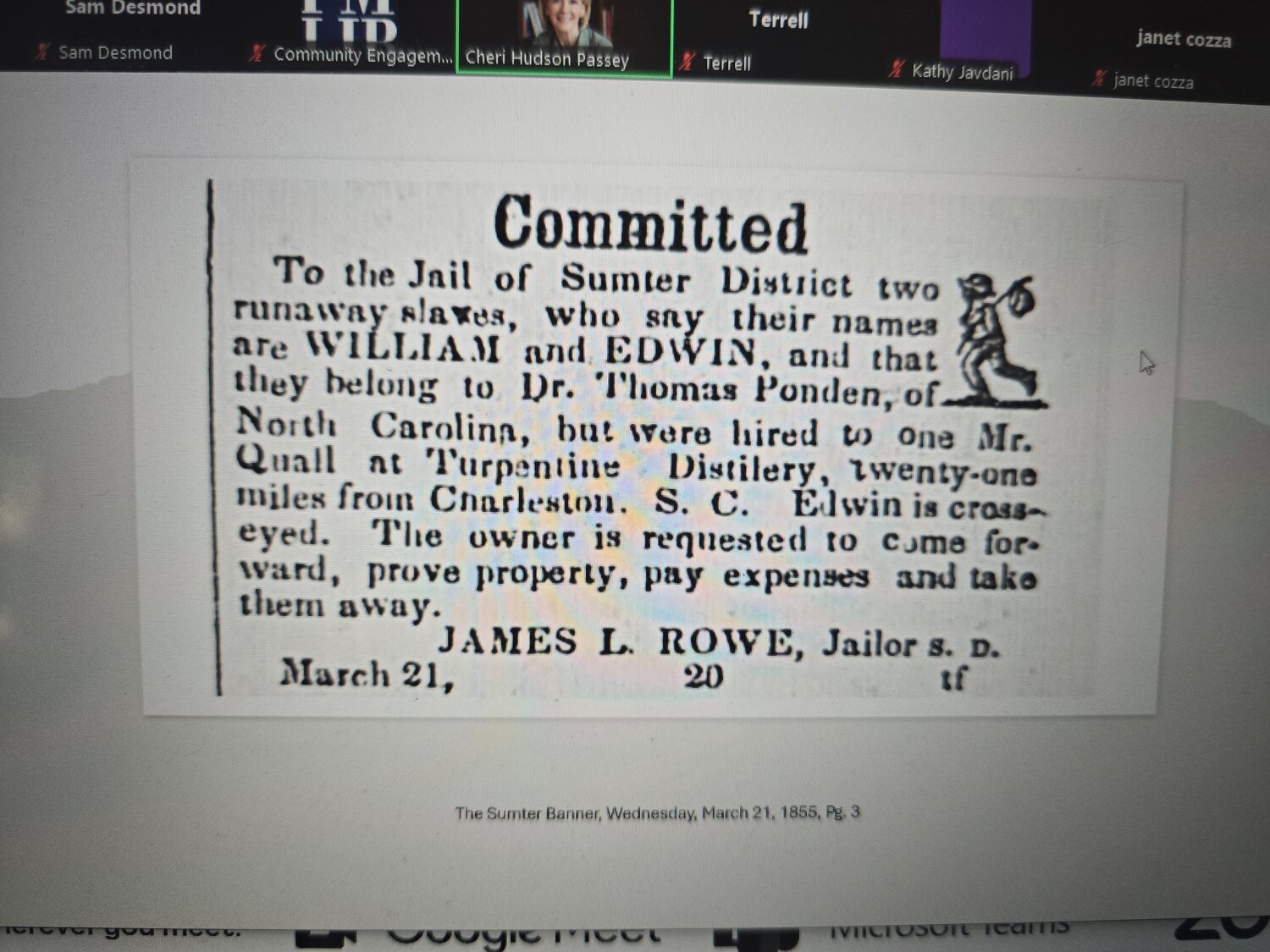
Another source was “hire out” contracts, where enslavers leased their slaves for work on other properties. In one instance, Passey was able to help a family connect with their ancestor after finding a hire-out contract to a turpentine factory.
Slave names were typically only first names and could change from owner to owner.
Another source was court records, where ownership was transferred. For one female slave, Betty, her first contract of being sold included the provision of being freed in 12 months. The court did not uphold the contract as subsequent owners invalidated the first owner’s contract.
“Very sad, so close to getting her freedom,” said Passey. “But what does this tell you if you find this in your family’s records? It tells you that chain of custody that Betty went through during this time period, we know where she was and where she went.”
“We want to go from discovery to connection. We want to take the information we are finding in our records and we want to do something with it. We don’t just want to leave it in there. These are families, these are people whose names have not been mentioned for generations, they are forgotten people,” said Passey.
Finally, Passey recommended looking at census records and finding the names of large landowners who possessed many slaves.








Comments
No comments on this item Please log in to comment by clicking here